Failure mode and effects analysis FMEA is an important tool for identifying the potential failures in design or manufacturing. It started in 1940s by the U.S. Military and was further developed by the aerospace and automobile industries. The FMEA approach facilitates the improvements when potential issues are found. Continue reading
#47 – WHY ERM FAILS? – MARY DRISCOLL/KRISTINA NARVAEZ
APQC’s Mary Driscoll recently spoke to Kristina Narvaez, President & CEO of ERM Strategies, about enterprise risk management (ERM). In the interview below, Kristina talks about several factors that tend to undermine ERM programs.
Mary Driscoll (photo): What are the essential components of an effective ERM program?
Kristina Narvaez: First off, I have yet to find the perfect ERM program. Some organizations have been more successful at implementing their programs than others. So, let’s consider why. Continue reading
#47 – WHAT MOTIVATES BLOCKERS TO RESIST CHANGE? – JOHN DYER
Blocker (noun) – Someone who purposefully opposes any change (improvement) to a process for personal reasons
‘Blockers’ can occupy any position in a company. They can be any age, gender, education level or pay rate. We tend to think of blockers as older, more experienced workers who have been with the company for a long time, and they don’t want to consider any other way to do things. Continue reading
#46 – RISK MANAGEMENT & ISO 9001:2015 – GREG HUTCHINS
Bio:
Greg Hutchins PE and CERM (503.233.101 & GregH@QualityPlusEngineering.com) is the founder of:
CERMAcademy.com
800Compete.com
QualityPlusEngineering.com
WorkingIt.com
He is the evangelist behind Future of Quality: Risk®. He is currently working on the Future of Work and machine learning projects.
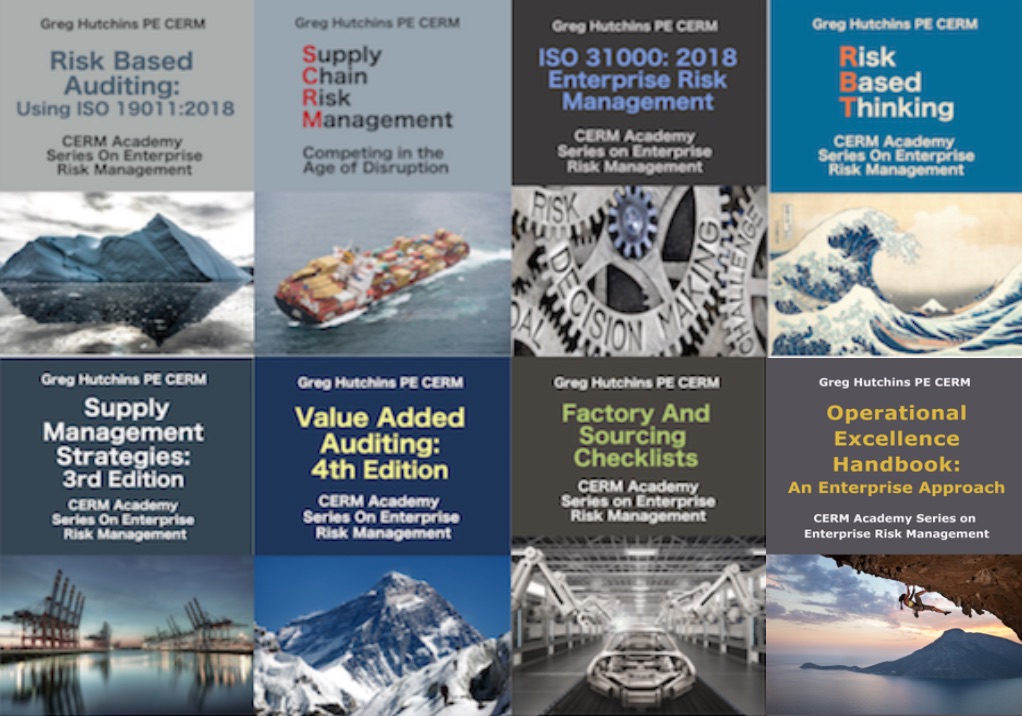
He is a frequent speaker and expert on Supply Chain Risk Management and cyber security. His current books available on all platform are shown below:
#46 – FICTIONAL RISKS – UMBERTO TUNESI
Oddly enough, though it is often said that imagination – or fiction – can never match reality.
Arts – generally speaking, such as literature, poetry, music, painting, sculpture, and so on – often anticipate real risks or thoroughly analyze them.
Why is it so?
Artists, be they writers or musicians or painters, etc., are not trained risk assessors, let alone risk managers. However, if not all but certainly some of them have a – let me say -‘sense of risk’ that’s uncommon, and often superior even to risk’s experts. Continue reading