
#66 – USE CREATIVITY TO BREATHE NEW LIFE INTO YOUR PRODUCTS – DANIEL BURRUS

BurrusDan_040

Many of us work in organizations that have been around for many decades.  For example, IBM – a popular employer – is over 100 years old.

Older organizations are great, but they often have a corporate culture that has not changed much over the years.  In addition, their traditional products and services continue to sell well, but the margins are much lower and there is much more competition.  Some people blame stagnation and lower profits on age—that only new and hip things sell these days. Continue reading

#65 – RISK MANAGEMENT: A PRIMER FOR LEAN QUALITY ASSURANCE – GINA GUIDO-REDDEN

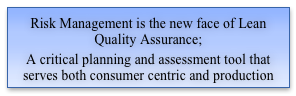
AAAIn this month’s installment of the Quality System series, we will take a closer look at what is becoming perhaps the most useful tool in the belt of today’s Quality professionals: Risk Management.

AA1

This blog has been designed for readers whose organizations haven’t yet formally adopted this practice.  The installment includes an overview of the terminology, objectives and processes involved in strengthening the existing Quality Systems with those designed to manage the risks inherent to product development and routine manufacturing and monitoring.

Continue reading

#65 – RISK DRIVEN BUSINESS MODEL – GREG HUTCHINS

Greg Hutchins pixWe have talked with a number of companies that are standing up risk programs.

Many companies are driven by ISO 9001:2015 and Risk Based Thinking.  Others are driven by US Federal risk requirements.  Some are driven by Ebola contagion fears.  Some are driven by cyber security and homeland security requirements. Continue reading

#65 – YOUR PERSONAL REALTIME SPC DEVICE – UMBERTO TUNESI

Umberto Tunesi pixEven if we’ve been educated as engineers strictly sticking to the principle quod demonstrandum erst (which is demonstrated) and to base our thoughts on numbers, it would be a big mistake to neglect our human nature, that makes us to perceive risk, and therefore subjectively predict its consequence(s).

Subjective risk perception is certainly useful as a primary source for risk prediction and consequent prevention but it can’t help much when we want or need to manage industrial or economical processes. Continue reading

#65 – MANAGING 21ST CENTURY ORGANIZATIONS – THE IRM

irm-logoIt quickly became apparent during our work that the environments analysed and the risk management problems they present, display many of the characteristics of complex systems. A complex system, like the weather, is one where even if you know everything there is to know about the system it is not sufficient to predict precisely what will happen, although it is possible to discern a range of outcomes. When simple systems are put under stress they can start displaying many of the attributes of complex systems. Continue reading