#6 – HOW TECHNICAL PEOPLE BLOW INTERVIEWS – ELIZABETH LIONS – CAREERS@RISK

Elizabeth Lions PixIt’s a shame when a technical person blows an interview.  It makes me uncomfortable because I get concerned we may have missed something in our hiring process.  What if our process caused some great engineer to not get the job?  What if all the skills were there, but we failed to ask the right questions.

Interviews are by and large difficult – for anyone.  The potential employee feels pressure and unnatural.  Technical people may have the most difficulty if their communication isn’t strong or clear.

Here are the five common things that go wrong in a technical interview:

Continue reading

#5 – SOCIAL MEDIA BAFFLES MOST ENGINEERS – ELIZABETH LIONS – CAREERS@RISK

Elizabeth Lions PixSocial Media baffles most engineers.  Like eating vegetables, we all know we need to be online and have a professional presence, but it gets confusing when it come to content, frequency and engagement. The most popular presentation I gave this year was on social media – how it works and why we should even bother.

Mostly, I get a lot of questions on LinkedIn. Questions such as:

  • What should be on my LinkedIn?
  • Do I have it filled out enough?
  • What else should I put on there?
  • Should I have three recommendations?
  • Does my picture look ok?
  • Do I have to have a picture at all?
  • What do they look at when they read it?
  • How will a recruiter find me?

Continue reading

#5 – VALUE ADDED AUDITING(TM) – GREG HUTCHINS – AUDITING@RISK

Quality risk auditing has become killer hot.  ISO developed a new auditing document, ISO 19011: 2011.  ISO says the purpose of the document is to:

ISO 19011:2011 provides guidance on auditing management systems, including the principles of auditing, managing an audit programme and conducting management system audits, as well as guidance on the evaluation of competence of individuals involved in the audit process, including the person managing the audit programme, auditors and audit teams.  ISO 19011:2011 is applicable to all organizations that need to conduct internal or external audits of management systems or manage an audit programme.

The challenge is that guidance standard does not teach auditor how to audit for quality risk and effectiveness.  Risk based auditing is becoming much more critical in the power, cyber security, food, aerospace, pharma, and many other sectors.

Take a look at a ASQ Quality Audit Division talk we gave almost 10 years ago:

https://insights.cermacademy.com/files/2012/11/ASQ-QAD-VAA-presentation.pdf

Or, take a look at the CERM workshop on Value Added Auditing or Risk Based Auditing at:

Risk Assurance™ (Value Added Auditing)

Bio:

Greg Hutchins PE and CERM (503.233.101 & GregH@QualityPlusEngineering.com)  is the founder of:

CERMAcademy.com
800Compete.com
QualityPlusEngineering.com

WorkingIt.com

He is the evangelist behind Future of Quality: Risk®.  He is currently working on the Future of Work and machine learning projects.

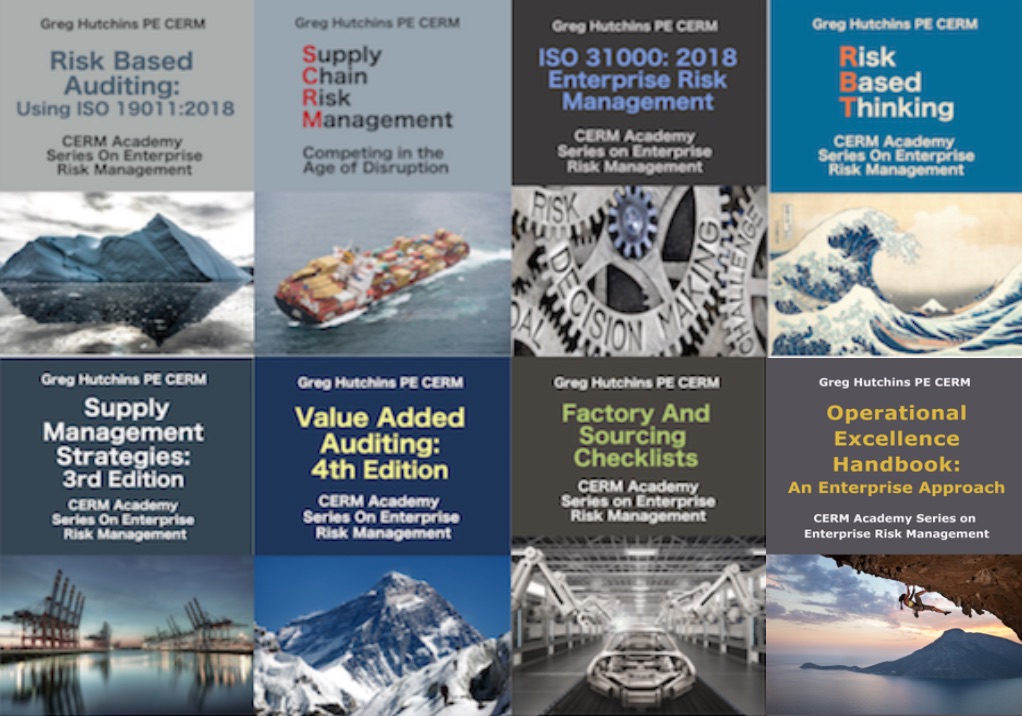
He is a frequent speaker and expert on Supply Chain Risk Management and cyber security.  His current books available on all platform are shown below:

#5 – IT’S ALL ABOUT MANAGING COMMUNICATION RISKS – ADINA SUCIU – COMMUNICATIONS@RISK

One of the main responsibilities of senior leaders is to guide the organization in achieving the strategic goals and sustain the organization.  But, many times, they don’t know the details of the daily work.  Many times there are too many layers and knowledge gaps between senior leaders and “the doers”.

These are the “vertical” gaps.  There are also the ‘horizontal” gaps: the people on the front line know very well their tasks and the activities their group is responsible for, but they may not know enough about the needs of the other groups that participate in the end-to-end process of creating that particular product or service for the customers.

All these gaps are risks that could be overcome by acknowledging the end-to-end operational processes and the end-to-end communication processes.  The information that has to fill the gaps is the list of quality requirements from one sub-process to another: what are the quality requirements for my outputs so that the group that comes after us has everything they need to do their best possible job.  Also, what are the requirements I have for the groups before me so that I can do my best possible job?  When all these requirements are well communicated and measurements to monitor them are in place, then the risk is better managed and the opportunity for “fires” is significantly lowered.

Let’s look at the communication process between Senior Leaders and the rest of the organization. Its capability may be measured in the quality of the information that flows up and down. Without acknowledging / defining the details of this process, there is no opportunity to measure the inputs/outputs of its sub-processes and have results that could be used in the decision making of guiding the organization in achieving the strategic goals.

The measurements throughout the communication process will reflect the efficiency and effectiveness of the two-way communications (the “how”) and the quality of information about overall operations (the “what”) that is needed to make accurate decisions.

When organizations take the time to establish and measure not only the operational processes, but also the communication processes, they have better information for their decision making.  Opening the door to strong, truthful, two-way communications, organizations develop a culture of empowering people which is a critical ingredient in fostering innovation.

This information also has to find a place from where it is easily accessible and transparent to the whole organization; and this is the connection to knowledge management which is the topic for another discussion.

If we take a few steps back from the tactical aspect of delivering the best product or services and think of the overall sustainability of an organization, one critical aspect is the level of its agility.  But an organization is as agile only as its workforce is agile.  With a culture of empowering people, organizations have more innovation and agility and the senior leaders have solid information to guide the journey toward strategic goals.

BIO:
Adina Suciu is the principal with Adav Consulting based in Seattle, Washington.  Adav provides expert lean, six sigma, and IT consulting services.  Adina can be reached at adina.suciu@gmail.com

#5 – DESIGN FAILURE MODES AND EFFECTS ANALYSIS – PAUL KOSTEK – DESIGN@RISK

For this month I thought I’d write about the Design Failure Modes and Effects Analysis (DFMEA) and how it can be used on a project.  Methods such as the DFMEA when used during the concept phase of the project can help a design team to work better together, share experiences and identify possible problems early.  Performing a DFMEA requires the entire team to gather and review the design and identify ways it might fail in use.  It’s best if this is done with the entire design team as this allows you to bring in the experience of all the members.

While brainstorming sessions aren’t always popular, or successful, these can work for DFMEAs if the group approaches it with an open mind and willing to share.  Once the possible failures are identified then next is  identifying the potential effects of  each failure, i.e. limited operation, loss of functions, total loss.  This is where experienced team members can play an important role by providing history from other projects, while new members bring in the ability to ask “why not” to the comment that it’s been tried before.  Based on these you can assign severity levels, where 10 is the highest  (likely)and 1 is the lowest (remote).  With this complete you move to assigning the detection rankings, i.e. how easy/hard will it be to determine what has failed.  Scoring for detection is typically 10 for low/uncertain detection and 1 is high/certain of detection.

With these completed we can calculate the Risk Priority Number (RPN). This is calculated by the following:

RPN: severity x occurrence x detection.

The RPN can then be used by the design team to make design decisions (concept stage), in later stages it can be used to make the product design safer and robust , and after the product is in production it  can be used to select features for further product improvement.

As in any effort related to risk it’s all about communications, sharing experiences and identifying the best ways to implement a solution that limits risk while providing max functionality/capability.  With technology changes something that failed in the past may be viable today, openness to considering all options is essential to product success.

BIO:
Paul Kostek is a principal of Air Direct Solutions a systems engineering/project management firm located in Seattle.  He works with companies in the aerospace and medical device industries.